
Understanding Feng Shui: Harmony Begins with Layout
Feng shui means "wind and water" and is built around five elements: fire, earth, metal, water, and wood. Two of these sit in direct tension: fire, represented by the stove, and water, represented by the sink. When these two are placed too close together, or directly facing each other, the layout is considered to disrupt the flow of the space.
Metal With Meaning



Where Should the Kitchen Sink Go?
The sink should not sit directly beside or opposite the stove, since this "water-fire clash" is considered to affect both relationships and health in feng shui tradition. Instead, sink, stove, and refrigerator should form a work triangle, three points positioned so each is reachable without crossing the others. This layout matches both feng shui principles and standard kitchen ergonomics.
How Does Sink Placement Change by Kitchen Layout?
| Kitchen Type | Ideal Sink Position | Why |
| L-shaped | Long side of the L, facing a window if possible | Promotes calm, maximizes natural light exposure |
| Galley (closed) | Not directly opposite the stove or door | Avoids the water-fire clash and door-facing conflict |
| Open-plan | Undermount sink in the island | Increases visibility, supports social interaction while cooking |
Metal With Meaning



Why Does Sink Material Matter in Feng Shui?
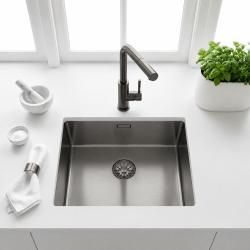
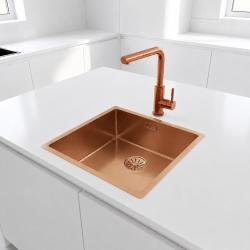
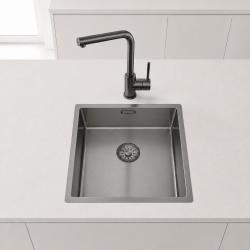
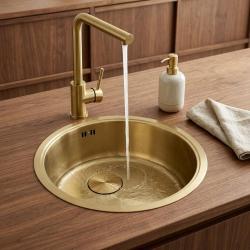
Metal represents resilience, clarity, and precision in feng shui, which is why stainless steel sinks carry particular symbolic weight in a kitchen. Pure.Sink's stainless steel sinks are designed in the EU and available in three PVD finishes: copper, matte black, and brushed gold.
Each finish carries its own symbolic association. Matte black represents strength and grounding. Brushed gold strengthens the earth element, which is traditionally used to balance the water element the sink already represents. Copper bridges the two, adding warmth without competing with either.
More than Aesthetics – Designing with Intention
Feng Shui is not about superstition, but about creating spaces that support your lifestyle. In luxury kitchens, we often become fascinated by textures and technology. But true harmony begins with how a space feels, not how it looks. A poorly placed sink can disrupt the energy, functionality, and your enjoyment in daily kitchen activities. But if you place the sink consciously, it becomes a silent partner in your routine, bringing form and function into balance.
Let your energy be reflected in your kitchen. And let that energy flow.
Frequently Asked Questions
Where does the sink go in feng shui kitchen design?
The sink should never sit directly beside or facing the stove; the two are considered elementally opposed. Positioning them as part of a work triangle with the refrigerator is the standard feng shui recommendation.
Why are fire and water considered to clash in feng shui?
Fire and water are two of the five feng shui elements, and they're treated as naturally opposing forces; placing their kitchen representations, the stove and the sink, too close together is believed to disrupt the home's energy flow.
Where should the sink go in an L-shaped kitchen?
On the long side of the L, ideally with a view of a window, which is thought to promote calm and make use of natural light.
Can a kitchen island have the sink in feng shui design?
Yes, an undermount sink set into an island is considered ideal for open-plan kitchens, since it increases visibility and supports interaction while cooking.
Does sink material matter in feng shui?
Yes. Metal is associated with resilience, clarity, and precision, which is why stainless steel sinks are considered particularly well-suited to feng shui kitchen design.
What does a matte black sink represent in feng shui?
Matte black is associated with strength and grounding, and is used to create visual anchoring in a space.
Why is brushed gold used to balance a sink in feng shui?
Gold represents the earth element, which is traditionally used to balance the strong water association of the sink itself.
Is feng shui kitchen placement just symbolic, or does it affect function?
Both. Feng shui sink placement principles closely mirror the standard kitchen work triangle used in ergonomic design, so the same layout that's considered energetically balanced also reduces the physical distance between prep, cooking, and cleanup.


